
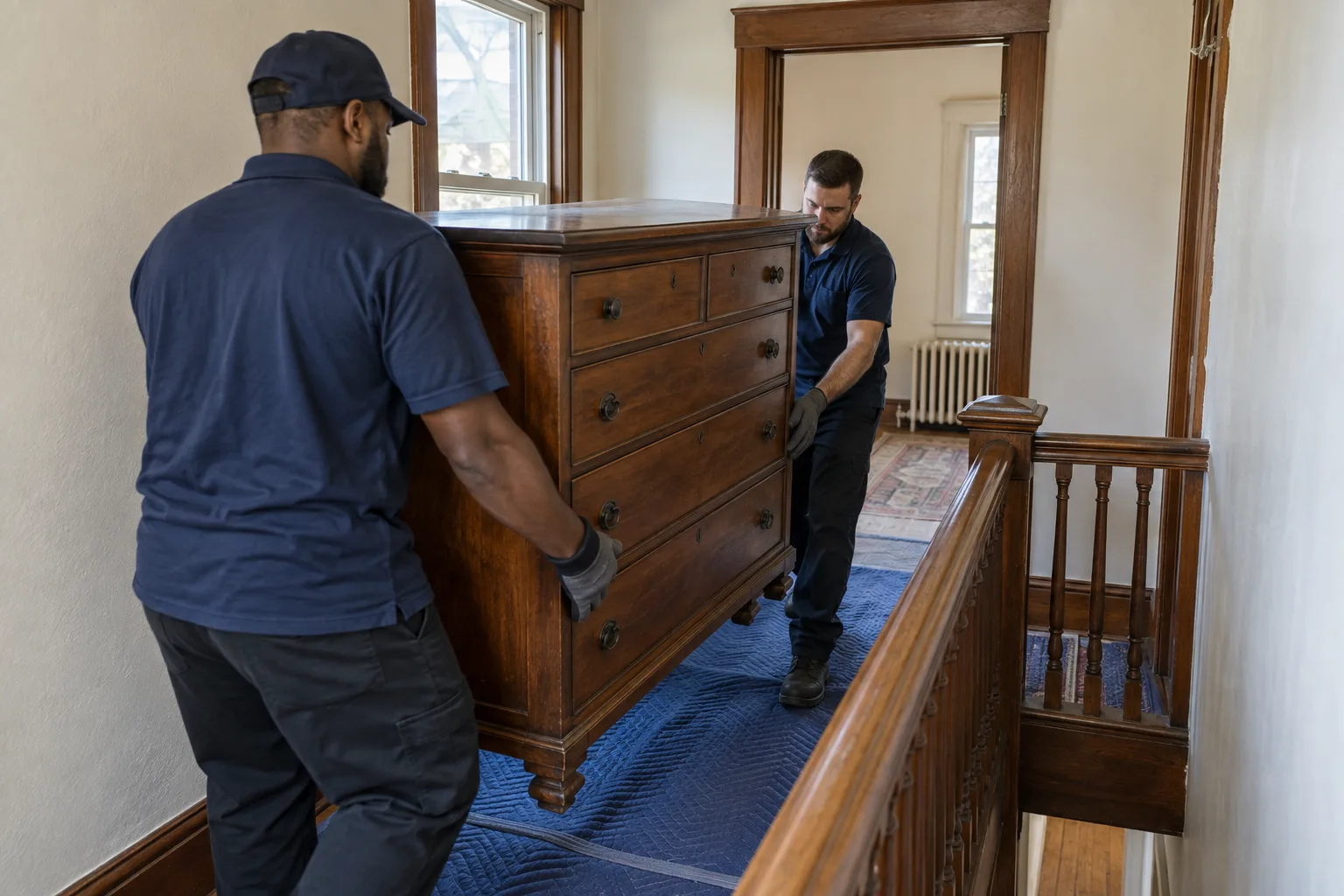
Measure three dimensions on the furniture, then trace the full exit path. Record door width and height, hallway width, stair width, ceiling height at turns, and the clear landing depth. Share the smallest numbers with the removal provider.
Measure the object in the position it may travel
For a sofa, record overall length, depth, and height. Then measure the height with removable legs or cushions taken off, but only if they are designed to come off without damage. For a dresser, record width, depth, and height, plus any protruding top, feet, or handles.
Do not assume a soft cushion will compress enough to solve the problem. Do not dismantle glued, nailed, powered, or spring-loaded parts unless the manufacturer allows it and you know how to do it safely. Describe the piece to the provider and ask whether disassembly is part of the furniture removal service.
| Measure | Where to measure | Record |
|---|---|---|
| Furniture width | Widest fixed point | _____ in. |
| Furniture depth | Front to back at the deepest point | _____ in. |
| Furniture height | Floor to highest fixed point | _____ in. |
| Narrowest door | Inside edge to inside edge with the door fully open | _____ in. |
| Narrowest hall or stair | Clear distance between walls, rails, or trim | _____ in. |
| Landing depth | Clear floor available for a turn | _____ in. |
| Turn height | Floor or stair tread to the lowest ceiling or fixture | _____ in. |
Walk the route in order
- Start at the furniture and identify the direction it would first move.
- Open every door fully and measure the clear opening, not the frame’s outside edge.
- Look for radiators, railings, low light fixtures, wall shelves, and door hardware that reduce clearance.
- At a stair or hallway turn, record both widths and the clear landing space.
- Continue through the porch, gate, sidewalk, driveway, or loading area.
A floor plan does not need to be polished. A quick sketch with measurements and arrows is easier to discuss than a series of unrelated numbers. Add photos of the object, the narrowest opening, and the hardest turn.
Leave the lifting plan to the crew
Furniture is bulky, hard to grasp, and often heavier on one side. OSHA advises workers to seek help when a load is too bulky to grasp, blocks their view, or cannot be handled safely. OSHA also recommends mechanical help for heavy objects and keeping access clear. Read OSHA’s material-handling precautions.
Measurements help the provider plan. They are not instructions for you to test-lift the piece. Leave the furniture where it is if moving it would put you on stairs, force a twist, or block the exit.
Access note to send with photos
“The dresser is 58 × 21 × 36 inches. It is on the second floor. The stair is 34 inches wide, the landing is 39 inches deep, and the narrowest door is 31 inches with the door open. Street parking only.”
Confirm four details on the call
- Whether the measurements and photos are enough to assess the route
- Whether the provider handles disassembly and reassembly of doors or furniture parts
- What surface protection, if any, is included
- Whether parking or building rules change the plan
If the object is attached to the wall, floor, plumbing, gas, or electrical service, say so. Furniture removal does not automatically include trade work. Contact the provider with the worksheet before pickup day.
- OSHA Materials Handling guidance, United States workplace safety guidance